
Visual field guide

Ship Gallery

Read a cruise ship beyond brochure polish. This independent English-language Australian cruise portal uses harbour departures, cabins, shared spaces and evening scenes to help you ask better questions before comparing Australian cruise sailings from Sydney, Melbourne, Brisbane or Fremantle. Photographs illustrate the kinds of spaces and South Pacific conditions you may encounter; they do not guarantee features on every ship.

Explore Australian Cruise Sailings

Compare Australian departures and itineraries in a new tab.

Route field / harbour departure / ship environments / planning context

How to use this field guide

Read the gallery like a planner

Each image is a comparison prompt, not a promise. Use the details you can see to form questions for ship reviews, cabin information, deck plans and itinerary research.

01

Movement and shared space

Scale and circulation

Atriums, decks and lounges reveal how a ship handles movement, meeting points and crowd distribution, especially on sea days and before evening events. Notice sightlines, stairs, lift access and seating zones rather than assuming an open-looking room will feel the same at every hour. Compare those clues with deck plans where available; no single layout is automatically better for every traveller.

02

Cabin comparison

Privacy and room use

Balcony imagery works best beside a cabin category description, bedding setup, storage, bathroom layout and likely view or obstruction notes. A balcony is not automatically the right choice for every budget or itinerary. Check the selected cabin and its deck position, because a general room photograph cannot confirm the privacy, furniture or outlook of a specific accommodation choice.

03

Editorial note

Time of day changes the ship

Daylit decks, dusk observation areas, pool scenes and evening interiors are different operating moods, not interchangeable amenities. Weather, itinerary timing, passenger mix and venue schedules can alter the feel. Consider whether you want quiet observation space, family activity, nightlife or social gathering points, whether you travel as a first-time cruiser, family, solo explorer or experienced sea traveller.

Departure frame

Harbour to open water

Australian sail-aways and sea days ask for different kinds of observation. Read them as separate parts of a voyage when shaping your shortlist.

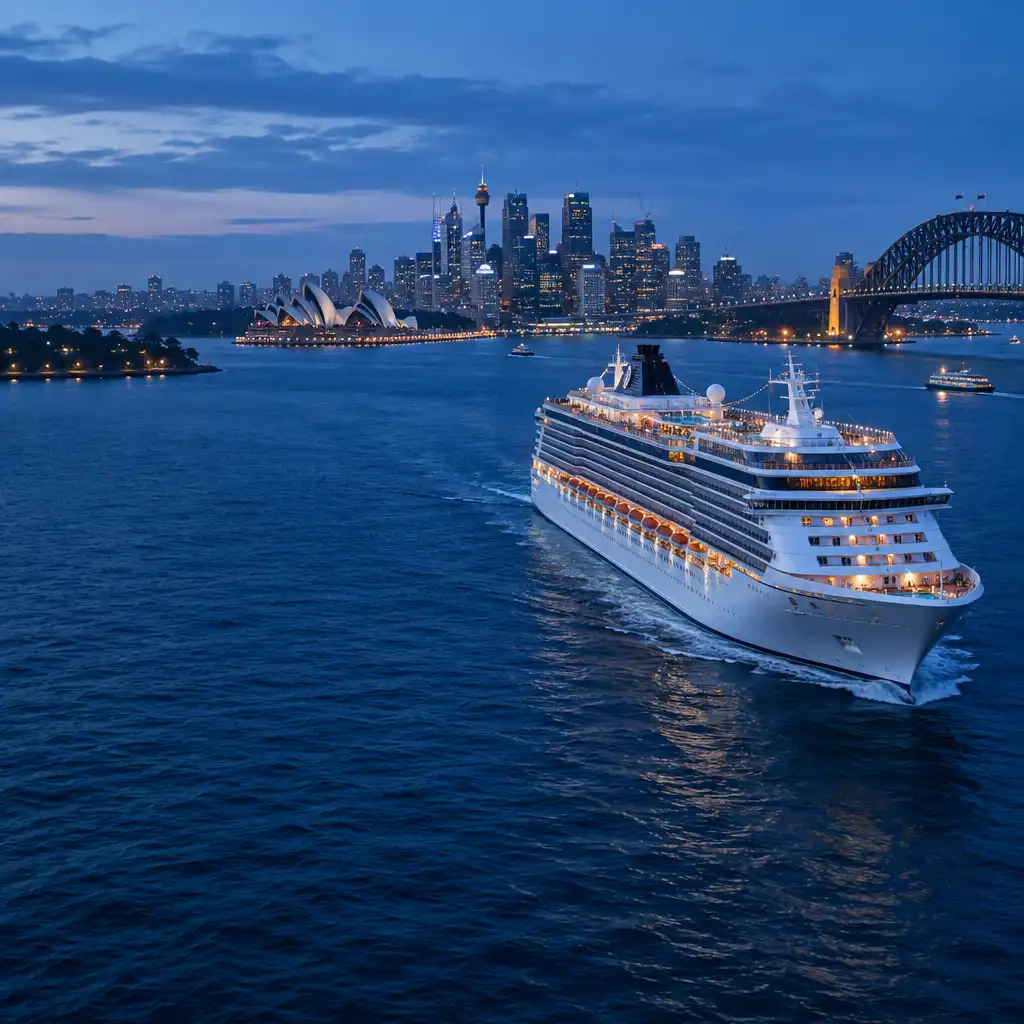
Port coordinate / Sydney Harbour

Harbour departure perspective

A Sydney Harbour image is useful for noticing bridge clearance, harbour-side viewing areas, sail-away timing and outward-facing deck space. Sydney is an iconic departure environment, but a photograph cannot confirm a berth, route or schedule. Check your departure documentation and the ship schedule for actual terminal details and timing. GEORGIOS DIMOSTHENIADIS also covers ocean liners departing Melbourne, Brisbane and Fremantle, each with its own port context.

Route field / South Pacific waters

South Pacific sea-day perspective

Open-water imagery is a cue to consider wind exposure, deck shelter and horizon views. Think about whether you prefer active outdoor space or quieter indoor observation options. Sea conditions and outdoor access vary by weather and voyage, so use the image as a starting point and compare itinerary details rather than treating it as a weather assurance.

Cabin field note

Cabin sightlines and private retreat

What the balcony view reveals

A balcony-stateroom image can help you judge natural light, seating scale, indoor-to-outdoor flow and the sort of horizon experience you might want on a sea day or early departure. It cannot confirm that every balcony room has the same furniture, view or privacy.

Consider deck position, neighbouring cabins and the amount of time your itinerary spends at sea. A room may be a sleep base, a quiet retreat or part of your social rhythm; GEORGIOS DIMOSTHENIADIS’s cabins and suites coverage can help turn that preference into a ship-specific comparison.

Verification checklist

  • Category descriptionRead what the selected cabin category actually includes.
  • Deck planCheck position, nearby venues and circulation routes.
  • Bedding setupConfirm the arrangement relevant to your party.
  • Accessible featuresReview relevant information where needed.
  • Obstructions and fare conditionsCheck notes attached to the chosen sailing and cabin.

Daily rhythm

Dining in the ship’s daily rhythm

Polished dining images are most useful when they prompt practical questions about atmosphere, timing and access—not when they are treated as a menu guarantee.

Australian seafood and a sense of occasion

A plated seafood scene can reveal lighting, table spacing and service atmosphere, but it does not confirm a menu, chef, venue brand or package inclusion. Dining expectations also differ between travellers and voyage lengths. Check menus, inclusions, dietary handling, venue access and reservation arrangements for the selected sailing.

Check before you sail: meal choices and arrangements can vary.

Social waypoint

The bar as a social waypoint

A bar scene can help you picture a pre-dinner meeting point, quieter conversation, live-music adjacency or a late-evening social setting. Venue programming and drink offerings can vary by ship and sailing. Consider your own social pace rather than assuming every lounge delivers the same kind of night.

Dining questions worth carrying forward

What is included?What needs booking?When may the venue operate?How are dietary requests handled?Where is it on the ship?

Carry these questions into ship reviews, dining guides, deck plans and itinerary research.

After dark

Public spaces after sunset

Look at evening deck imagery as a way to compare atmosphere, exposure and adjacency—not as a fixed programme.

Dusk observation: room to look outward

An observation setting may suit travellers seeking horizon views, a quieter pause or a scenic place around sail-away and sunset. Access, wind and crowd levels vary, so check deck plans and sailing schedules rather than expecting guaranteed quietness or a particular view.

Evening deck field

Pool deck: visible energy after dark

A lit pool deck can signal an area worth investigating for family activity, entertainment, music and social space. Evening programmes vary by ship and voyage. Families, adults and groups can compare how close they want to be to activity without assuming the deck will always be busy or calm.

Ship architecture

Atrium orientation and ship architecture

The ship’s indoor crossroads

A multi-storey atrium often acts as a visual anchor between decks, venues, guest services or gathering areas, though its exact role and nearby facilities differ by ship. Read deck plans alongside imagery. Lift banks, stairs and long sightlines can be useful visual clues, but they are not universal features or proof of a particular layout.

For groups and independent explorers

A recognisable meeting point can help social groups coordinate and can give solo travellers a legible central point from which to explore. That is an editorial observation, not a promise of easy navigation or an accessibility outcome. Use the scene to ask how the vessel’s public floors relate to one another.

Read the vertical clues

  1. Open levels
  2. Directional signage zones
  3. Seating pockets
  4. Venue entrances
  5. Public-floor relationships

Destination horizons

Where the voyage can take you

A ship image is a useful starting point for thinking about route character, but destination details belong to the itinerary.

Destination field

From harbour to open water

The direction of a voyage shapes the scenery, the sea days and the kind of ports you may visit. Compare South Pacific crossings, New Zealand coastal routes, the Great Barrier Reef and southern or remote coastlines as distinct travel experiences.

Read the itinerary, not just the picture

A photograph can suggest open water and horizon views, but it cannot confirm a port call, scenic-cruising day or seasonal condition. Use the cruise destinations guide and the individual sailing details to compare what a route actually includes.

Questions to carry into your shortlist

  • Route regionWhich destinations does the sailing actually visit?
  • SeasonWhat conditions should you expect at that time of year?
  • Sea daysHow much time is spent between ports?
  • Shore timeHow long does the itinerary allow in each destination?
  • Departure cityIs the homeport practical for your travel plans?

Route sequence

Build a visual shortlist

Move from image-led observations to a practical research sequence before comparing actual sailings.

01

Start with the voyage frame

Choose Sydney, Melbourne, Brisbane or Fremantle as a starting coordinate, then identify the broad style of sailing you want. Ports do not offer identical sailings, so treat departure point as the first comparison filter.

02

Match spaces to your travel rhythm

Note your non-negotiables across cabin privacy, dining style, outdoor space, central gathering areas and evening atmosphere. The gallery categories help you name priorities without prescribing one ideal ship.

03

Verify ship-specific detail

Use ship reviews, cabins and suites information, and deck plans to confirm that a feature noticed in an image relates to the particular vessel and accommodation choice. Imagery is a starting point, not confirmation.

04

Compare dates and itineraries

Finish by comparing the actual departure dates and itinerary options that fit your visual and practical shortlist. This is where the route becomes a sailing comparison.

SydneyMelbourneBrisbaneFremantle

Route endpoint

Find an Australian sailing to compare

Take your visual shortlist into a comparison of Australian cruise sailings by departure date and itinerary. The next step opens the Australian cruise finder in a new tab; this gallery does not list real-time availability.

Explore Australian Cruise Sailings

GEORGIOS DIMOSTHENIADIS is an independent cruise information and review guide. Use this visual field guide alongside ship-specific details and your own selected sailing information.